
Ionic Anti-static Agent Anti-static Agent
Ionic Anti-static Agent GCASTAT® IC-1 Series
Liquid ionic anti-static agent that solves the dust, contamination, color limits and migration issues of carbon black, CNT and surfactants, holding its performance in hot, dry conditions.
GCASTAT® IC-1 Series is an advanced material that can replace conventional anti-static technologies as the electrical and electronics industries evolve. It solves the problems of carbon black, CNT and surfactants: dust, part contamination, barcode reading limits, color limits, hazardous substances, reverse current, breakdown failure, migration, performance loss over time and with humidity, and poor heat resistance.
Key Benefits
- Excellent anti-static performance (short decay time and half-life)
- High heat resistance (<300℃)
- High transparency
- Anti-yellowing
- Physical and chemical stability
- Freedom of coloring
Applications
- Silicone rubber
- Urethane rubber
- TPU (ether / ester)
- PMMA
- Nylon 6.6
- ESD flooring
- ESD sheet
- ESD coating
- ESD film
- ESD package
- Carrier tape
- ESD adhesive
Recommended Dosage
- 0.05–2.0%
- Typical dosage
- Max 5.0%
- Maximum dosage
Recommended Grade by Polymer
| Product | Polymer | Loading (%) | Surface resistance (Ω/sq) |
|---|---|---|---|
| GCASTAT Ⓡ IC-1 | Silicone rubber | 0.05~ Max. 1.0 | 10E10~11 |
| GCASTATⓇ IC-1H | Silicone rubber | 0.05~ Max. 1.0 | 10E10 |
| GCASTATⓇ IC-1P | Silicone rubber | 0.05~ Max. 1.0 | 10E9~10 |
| GCASTATⓇ IC-1M | Urethane rubber TPU Ether / Ester PMMA Nylon 6.6 | 2.0 ± 0.5 2.0 ± 0.5 0.5 ± 0.5 2.0 ± 0.5 | 10E8 10E8 10E9 10E9~10 |
← Swipe the table sideways →
Physical Properties
| Items | Results | Test Methods |
|---|---|---|
| State | Liquid at 20 ℃ | With reference to * KHMSCA |
| Flash Point (Closed Cup) | No flash occurred under 93 ℃ | ASTM D56 : 2010 Tag Closed Cup |
| Flash Point (Open Cup) | 131 ℃ | ASTM D92 : 2012a Cleveland Open Cup |
| Autoignition Temperature | No Spontaneous combustion under 200 ℃ | ASTM E659(78) : 2005 |
| pH | 3.6 ~ 4.6 * Sample : H2O = 1: 5 (v/v) | With reference to KS I ISO 10390 : 2005 |
| Density | 1.2 at 20 ℃ | KS M 0004 : 1997 (2012 confirmation) |
| Water Solubility | Insoluble at 20 ℃ | With reference to * KHMSCA |
| Spontaneous Combustion Test | No Spontaneous combustion at 20 ℃ | ** UN TDG Test N.2 |
| Water Contact Test | No water reaction hazard at 20 ℃ | UN TDG Test N.5 |
| Pressure Vessel Test | No self-reaction hazard - No rupture of the 0.6 Mpa disc of the vessel * orifice range = (0.6 ~ 9.0) mm | UN TDG Test E.3 |
← Swipe the table sideways →
* KHMSCA : Korea Hazardous Materials Safety Control Act. ** UN TDG : UN Recommendations on the Transport of Dangerous Goods – Tests and Criteria
Half-life Comparison — Silicone RubberKS K 0555:2010 Method A, 6 kV
| Sample | Half-life, press cure (sec) | Half-life, post cure (sec) |
|---|---|---|
| GCASTATⓇIC-1H 0.05% | 1.2 | 1.8 |
| GCASTATⓇIC-1H 0.1% | <1.0 | < 1.0 |
| USA C Company 2.0% (Stearamidopropyldimethyl-2-hydroxyethylamm-onium nitrate) | > 60 | N/A |
| Japan S Company Antistatic Silicone Rubber | 5.5 | 7.3 |
| Experimental Condition | 170℃/10min | 200℃/4hr |
← Swipe the table sideways →
Decay Time — Silicone RubberTime to 10% after applying 1,000 V
| IC-1H loading (%) | 0.0 % | 0.1 % | 0.5 % | 1.0 % |
|---|---|---|---|---|
| Measured voltage (V) | 300 V | 1.9 V | 3.8 V | 3.8 V |
| Measuring time (sec) | 8.6 | 1.2 | 1.4 | 0.07 |
| Decay time (sec) | >> 10 | < 1 | < 1 | < 0.07 |
← Swipe the table sideways →
Surface Resistance (Ω/sq)KS M 3015:2008, 500 V
| IC-1H loading (%) | 0.1% | 0.5% | 1.0% |
|---|---|---|---|
| Press cure (170℃/10min) | 2.61 × 10¹⁰ | 2.19 × 10¹⁰ | 2.17 × 10¹⁰ |
| Post cure (200℃/4hr) | 1.25 × 10¹⁰ | 6.95 × 10¹⁰ | 3.18 × 10¹⁰ |
← Swipe the table sideways →
Volume Resistance (Ω·cm)KS M 3015, 500 V
| IC-1H loading (%) | 0.1% | 0.5% | 1.0% |
|---|---|---|---|
| Press cure (170℃/10min) | 2.57 × 10¹⁰ | 2.19 × 10¹⁰ | 2.70 × 10¹⁰ |
| Post cure (200℃/4hr) | 7.37 × 10¹⁰ | 3.01 × 10¹⁰ | 2.49 × 10¹⁰ |
← Swipe the table sideways →
Half-life after Heat Aging
| Condition (IC-1H 0.05%) | Half life (sec) |
|---|---|
| Press cure (170℃ x 10 min) | 1.2 |
| Post cure (200℃ x 10 min) | 1,8 |
| Heat aging (200℃ x 100 hr) | 3 |
| Heat aging (200℃ x 300 hr) | 3 |
← Swipe the table sideways →
Half-life after 300℃ · 330℃
| Loading (%) | 0.1% | 0.5% | 1.0% |
|---|---|---|---|
| Half-life (sec) | <1 | < 0.6 | < 0.5 |
← Swipe the table sideways →
Surface Resistance after 300℃ · 330℃ (Ω/sq)
| IC-1H loading (%) | 0.1% | 0.5% | 1.0% |
|---|---|---|---|
| After 300℃ x 10 min | 1.31 × 10¹¹ | 5.69 × 10¹⁰ | 2.63 × 10¹⁰ |
| After 330℃ x 10 min | 1.38 × 10¹⁰ | 4.26 × 10⁹ | 1.02 × 10¹⁰ |
← Swipe the table sideways →
Volume Resistance after 300℃ · 330℃ (Ω·cm)
| IC-1H loading (%) | 0.1% | 0.5% | 1.0% |
|---|---|---|---|
| After 300℃ x 10 min | 5.94 × 10¹¹ | 2.74 × 10¹⁰ | 1.72 × 10¹⁰ |
| After 330℃ x 10 min | 2.26 × 10¹⁰ | 2.58 × 10⁹ | 2.35 × 10⁹ |
← Swipe the table sideways →
Physical Properties — No Effect on Properties or Cure Time
| Items | None | IC-1 H 0.05% | IC-1 0.1% | US Company C agent 2.0% |
|---|---|---|---|---|
| Hardness (Shore A) | 40 | 40 | 40 | 38 |
| Tensile St. (kgf/cm²) | 85 | 86 | 86 | 73 |
| Elongation (%) | 713 | 721 | 725 | 789 |
| Tear St. (N/mm) | 24 | 24 | 24 | 21 |
| ML (Ibf) | 0.94 | 0.93 | 0.95 | 0.86 |
| MH (Ibf) | 11.24 | 11.31 | 11.35 | 9.23 |
| ts 1 (sec) | 36 | 37 | 37 | 41 |
| tc 50 | 63 | 65 | 65 | 78 |
| tc 90 (sec) | 122 | 124 | 125 | 182 |
← Swipe the table sideways →
Product
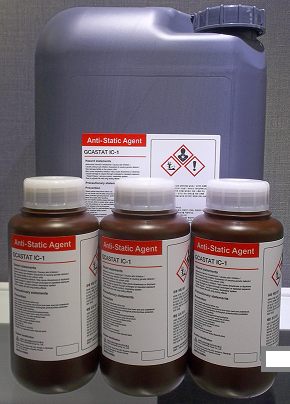
GCASTAT® IC-1 Series